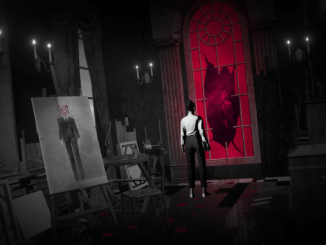
The Game: Half-Life 2 (2004)
Original Platform: Windows (Steam)
Version We Played: Original Release, on Steam Deck
Verdict: All I want for Christmas is a gravity gun.
A confession: I quit Half-Life 2.
It was probably ten years ago, which is to say, a decade after its 2004 release. I’d picked it up as part of the fabled Orange Box (of which more in a moment), but after working my way through the masterpiece that is Portal, I found Half-Life 2 slow, frustrating, outdated.
In retrospect, that wasn’t fair.
Portal is such a singular experience – a metafictional dark comedy masquerading as a AAA puzzle game, not to mention one of the smartest games ever made – that expecting anything to live up to it was a mistake. I set aside H-L 2 back then (right around the third or fourth antlion beach), but, inspired by conversations with friends and far too many glowing retrospectives, I decided, this year, to give it another chance.
What I found was a first-person-shooter which is oh-so-much more than that. Rigorously designed, fiercely intelligent, Half-Life 2 is a breathtakingly entertaining game, brimming with great ideas (many of which would be borrowed/stolen by the many games it would go on to inspire), and most of all a joy to play. Sure, it’s not Portal, but then it doesn’t have to be.
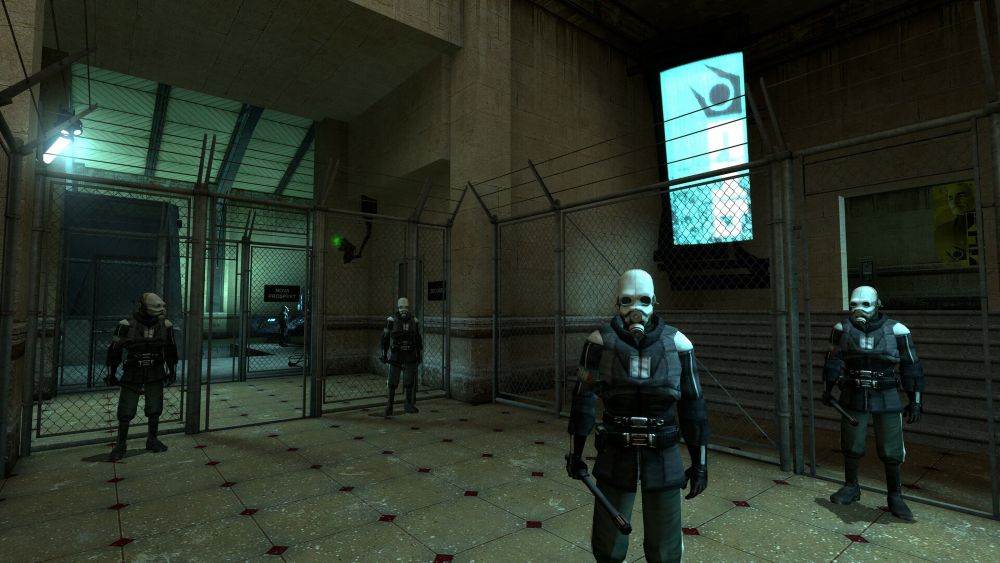
Half-Life 2 is a puzzle trapped in a shooter.
More specifically, it’s a brilliant, endlessly inventive, physics-based puzzle game, trapped in a very good but admittedly creaky first-person-shooter, with all the baggage that comes with it.
The sequel to 1998’s (also very good) Half-Life, H-L 2 continues the story of Gordon Freeman, a theoretical physicist who, through events which are, frankly, partly his own fault, has gotten mixed up in an intergalactic cold war pitting several alien factions against humanity. In the first game, spoilers, Gordon succeeded in repelling invaders from the Xen dimension, only for a mysterious figure known as “G-Man” to recruit Gordon into the ranks of an unnamed, shadowy organization.
Fast-forward six years – twenty years in game time – and 2004’s Half-Life 2 begins with Gordon awoken from the stasis he was placed in at the conclusion of the first game. In the twenty years since the events of Half-Life, Earth has been invaded by not one but two alien forces, new foe the Combine having already conquered the planet (with, it’s implied, the support of some collaborating humans). When Gordon wakes up, he discovers a world at war – a human rebellion fighting the Combine, the Combine staving off endless hordes of Xen aliens, returning from the first game.
Details about this war, about the motivations of various factions, about the remarkable passage of time, remain frustratingly vague throughout – one of the unfortunate knock-on effects of H-L 2’s approach to storytelling, in which key details are omitted, and in which our eternally silent hero fails to ask some fairly basic clarifying questions. Indeed, if H-L 2 has any real weakness, it’s the rather perfunctory narrative, which doesn’t entirely cohere and which ends on a cliffhanger which, rather infamously, has yet to be resolved.
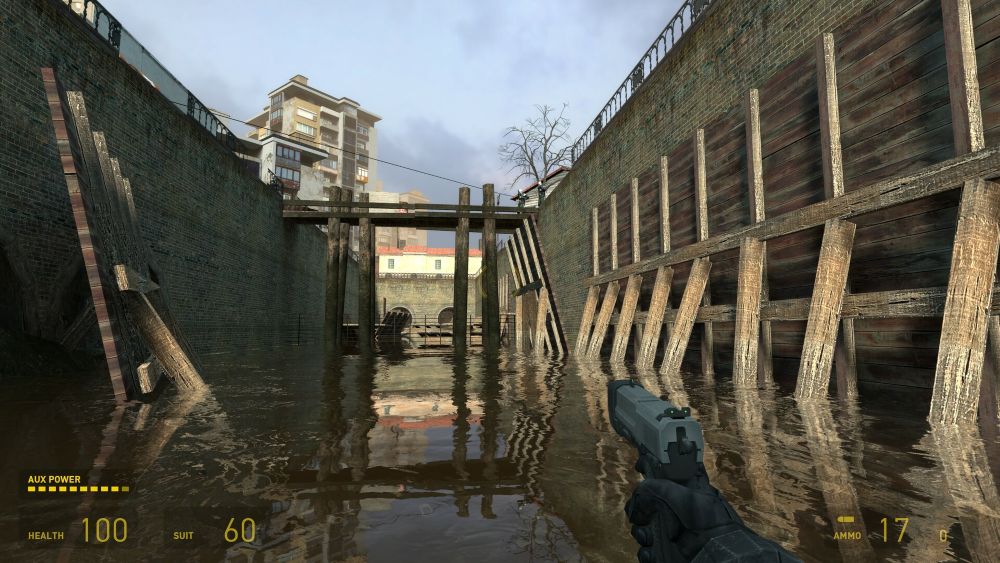
When Half-Life 2 is firing on all cylinders, it’s the absolute best that an FPS can be. The gravity gun, in particular, opens up – and encourages – such wildly entertaining experimentation it can be easy to forget Gordon has a whole arsenal of weapons to choose from. (That is, until a Combine soldier unloads a shotgun in your face, and you realize you should probably stop throwing boxes at them.)
Half-Life 2 is also a rollercoaster ride of brilliant ideas, each section offering something novel, something exhilarating, while also building on everything which came before.
One moment, H-L 2 is a slowburn horror game, the zombie-cum-haunted house stylings of the Ravenholm chapter (ominously subtitled, “We Don’t Go To Ravenholm”) an obvious standout. The next, it’s a Halo-style vehicular combat journey across Highway 17, zipping past enemies, slowing down for the occasional pitched battle. Sometimes, H-L 2 is a co-op or squad-based shooter, Gordon joined by an array of computer-controlled allies including quasi-love interest Alyx (later to star in her own, widely heralded, virtual reality game). In these moments, H-L 2 even adds a temporary squad control sub-menu, letting you quickly direct allies to take up position or go on the offense.
Impressively, while Half-Life 2 may be the progenitor of environmental storytelling – in which environmental details (rather than scripted cutscenes) offer glimpses of a broader narrative – its environmental storytelling is still excellent, surpassing in certain places even the BioShocks and Half-Lifes of the world. Sure, there are the simple things – like stumbling across a corpse next to a weapons cache, the poor soul having run out of food/water before rescuers could arrive – but then there are the more intriguing ones, like the blood-splattered walls, the ominously placed chair in the middle of a room, hinting at the terrible things which happened here.
This helps H-L 2’s world feel lived in, organic – as do the actual glimpses of other storylines playing out in real-time, as, for example, when you spot Combine thugs interrogating a frightened civilian, or when you come across an active firefight between your enemies, the alien-zombie hordes menacing a Combine squadron. Even today, in 2026, it’s cool to just stand back and watch these battles play out, waiting for your moment to pick off the survivors. In Half-Life 2’s case, the adage “the enemy of my enemy is my friend” does not apply.
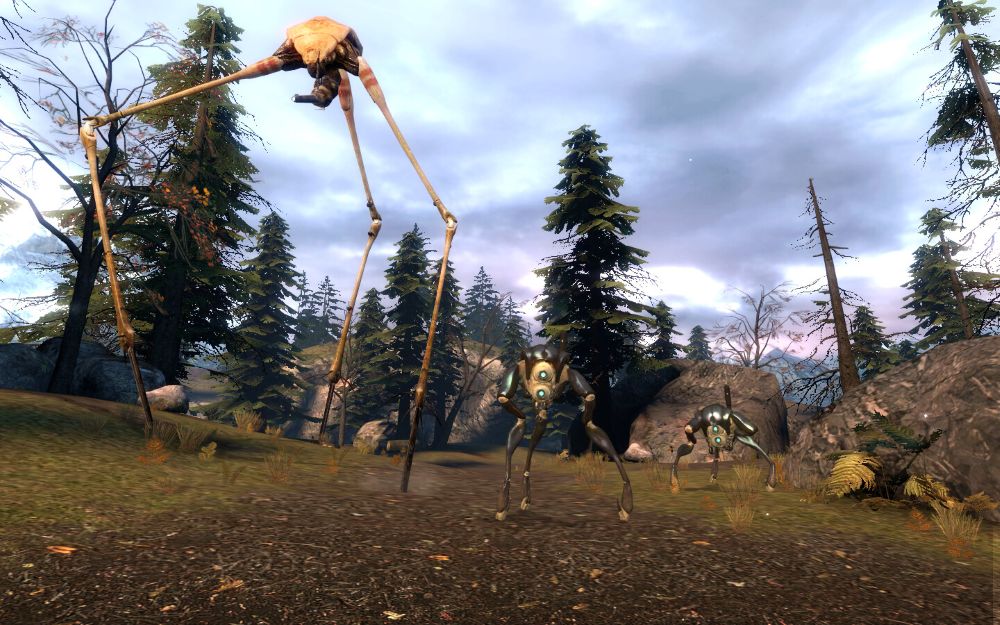
H-L 2 even makes space for some bona fide scripted set pieces, again played out in real-time. Highlights include an Airboat (think mini-hovercraft) chase where you’re weaving through falling smokestacks, or a rail bridge crossing in which a high-speed train races through just in time for you to dodge it, or – one of my favourites – the ominous arrival of the War of the Worlds-styled Striders, enormous tripods which can stomp or laser beam you to death in an instant.
Thanks to some very brilliant hidden scripting, these events appear to play out spontaneously, even if they’ve actually been finetuned down to the millisecond by the team at Valve.
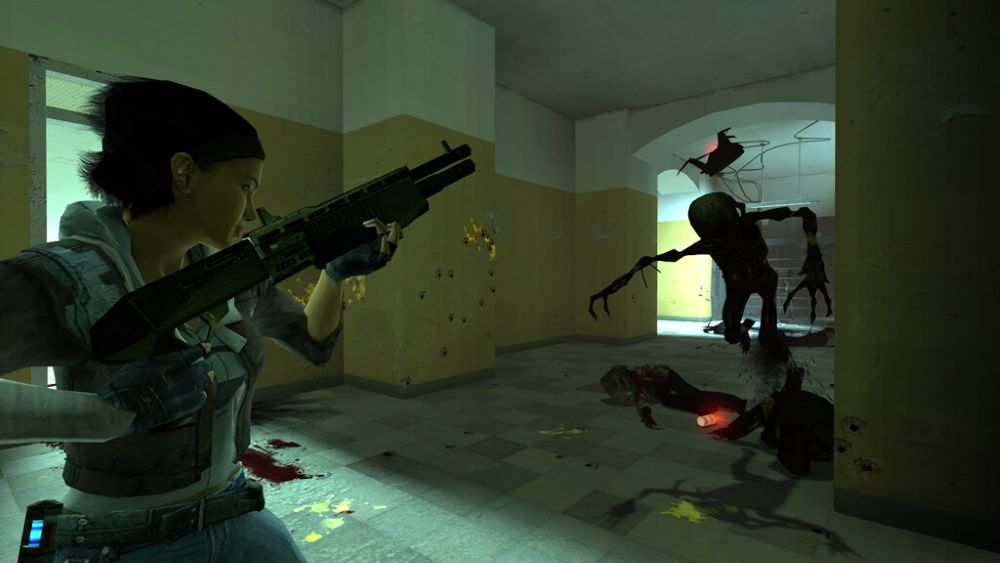
I didn’t notice it as much the first time around, but my second encounter with Half-Life 2 cements just how indebted it is to the classics of sci-fi past.
Sure, the headcrabs are basically just reskinned facehuggers, but by the time H-L 2’s “fast zombies” are aggressively smashing through skylights and scurrying along walls, it’s impossible to ignore the Alien influence. The evolved, poisonous headcrab, in particular is Alien-coded, with its devastating attacks which knock you down to a single point of health.
There’s more. The biomechanical Striders are, as mentioned, lovingly borrowed from H.G. Wells’s War of the Worlds. The mysterious G-Man is basically just The X-Files’ Cigarette Smoking Man. The omnipresent, all-seeing Administrator Breen, Gordon’s former boss and now leader of Earth’s Vichy-style government, is heavily Big Brother-coded. (Breen’s name, incidentally, is a likely nod to Star Trek: Deep Space Nine’s Breen species, the grunts in the intergalactic empire of DS9’s The Dominion.) The list goes on.
I say this not simply to congratulate myself for being a mega-sci-fi nerd, but to highlight how expertly Valve melds all these influences into something so memorable and, yes, unique. Sure, its story isn’t quite up to snuff – there are, frankly, too many unresolved details, particularly in light of Valve’s ongoing failure to deliver on the promised Half-Life 3 – but it’s still an impressive inheritor of a proud sci-fi tradition.
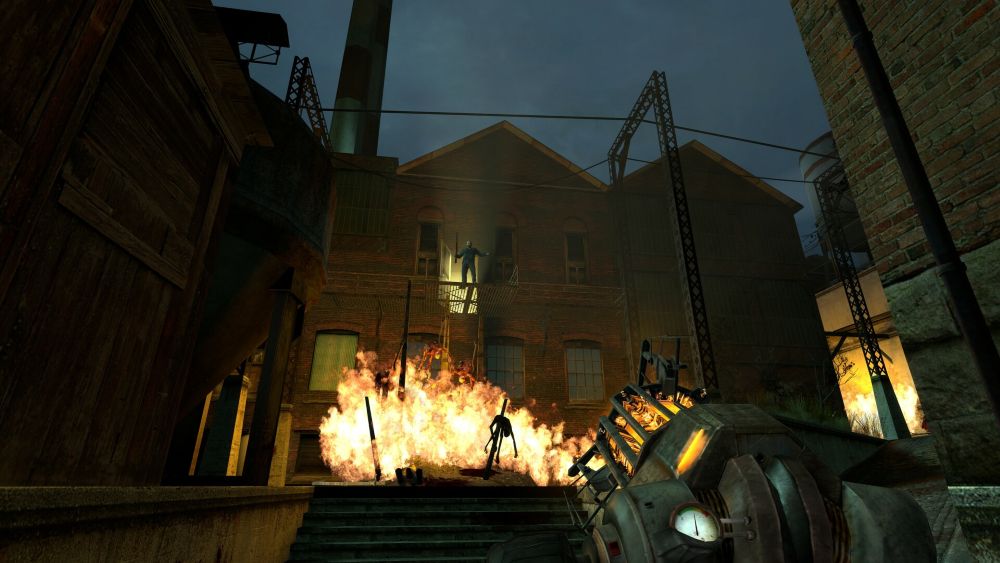
From a purely gameplay perspective, H-L 2 excels from top to bottom. This is a game which admirably resists handholding, while at the same time pushing you to experiment with its many tools and systems. Enter a room full of dropped saw blades? Who could resist hoovering them up with the gravity gun and then launching them at enemies. Spot a deviously-placed ceiling barnacle, its extended tongue ready to scoop you up like a Venus flytrap? Try rolling a nearby explosive barrel towards it, see what happens. Half-Life 2 is full of moments like these, mini-dioramas which encourage experimentation on the part of the curious player.
The impeccably designed physics system – see gravity gun, above – is probably the best part of the game. So many times, I’d encounter an environmental puzzle, a pathfinding challenge, a just-out-of-reach item, which forced me to stop, think, and figure out how to use the game’s physics system to find a way forward. (You spend a surprising amount of time constructing simple levers and bridges.) You can easily spot the seeds of Portal in these moments, when H-L 2 ceases to be a shooter and turns into a meaty, intelligent, physics-based puzzler.
For a game about blowing up alien zombies, H-L 2 also finds time for subtle details. Take, for instance, the game’s mind-controlling headcrabs, which have a nasty habit of turning humans into zombies. Occasionally, upon killing a zombie, the headcrab will fall off, revealing the tortured face of the infected human underneath. The entire Ravenholm section, in which the devoutly mad Father Grigori has created a sort of contained ecosystem for his “flock” of zombies, slowly reveals a whole crazed backstory without once spelling it out for the player. Elsewhere, discarded newspapers found throughout the world reveal the devastating nature of the Combine’s invasion of Earth – details which can easily be overlooked unless you take the time to stop, read, survey.
Half-Life 2 is, of course, an imperfect artifact of an imperfect era of game design.
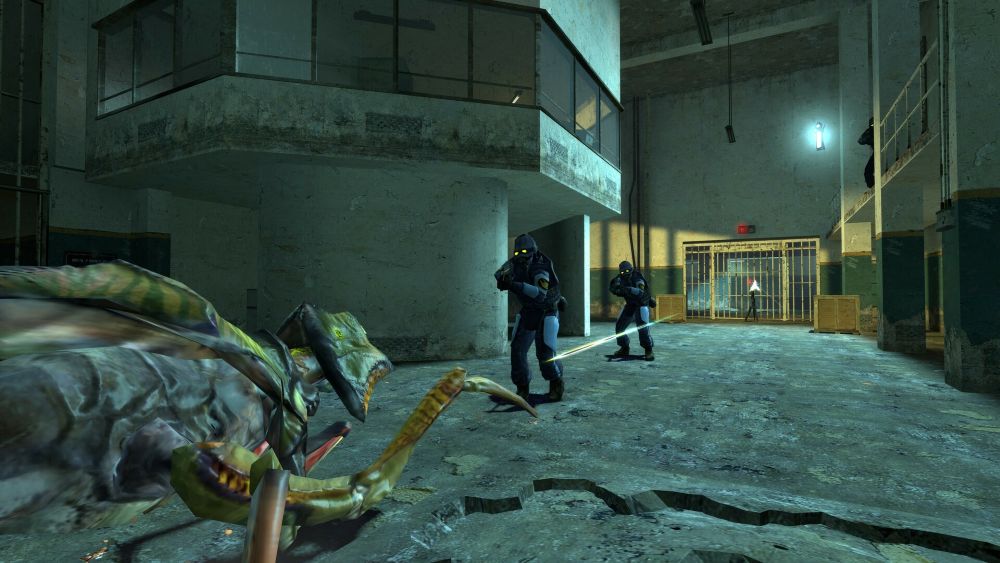
The actual gunplay is the least interesting part of the game, with bullet sponge enemies which require a few too many shots to defeat, and sporadic placement of ammunition and medkits, which can occasionally trap the player in an endless checkpoint loop of defeat. (I had to reload earlier saves a very small handful of times.) Half-Life 2, by design, also refuses to point you in the right direction – an idea which mostly works, but can occasionally grow frustrating when your pathfinding is persistently interrupted by enemy attacks. (I found the waterborne Airfloat chapters of H-L 2 to be particularly annoying in this regard.) To its credit, H-L 2 also lacks boss fights in the traditional sense, though there are still a few progression wall battles which feel slightly unfair. This is especially true when Gordon is faced with waves of endlessly refreshing enemies, and you begin to wonder when the fight will finally peter out.
The conclusion, on the other hand, is excellent, deftly avoiding the mistakes of its predecessor’s godawful trampoline boss, and instead offering a mini-pitched battle in which Gordon faces a series of enemies while trying to deactivate an enemy reactor. It fits well within the overarching story, and offers narrative payoff for Gordon’s adventures dating back to the first game.
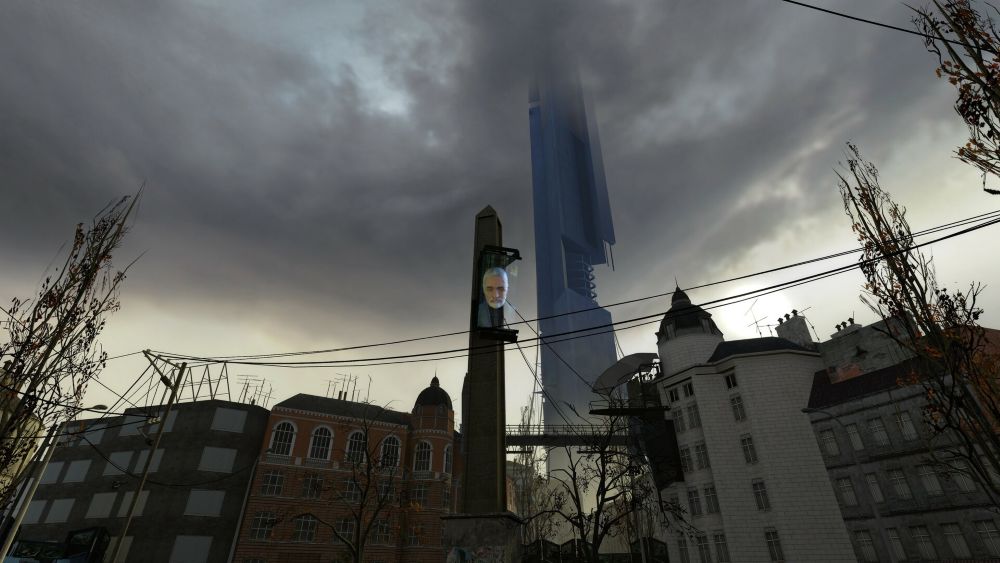
What else can be said about Half-Life 2, by someone who’s only played it through for the first time in 2026? Well, the voice acting is great – I was delighted to hear Star Trek’s Ro Laren, Michelle Forbes, in a key role – and the graphics are very good for the era. It’s not scary, exactly, but the horror vibes are strong.
It’s also, as noted, impossible to discuss Half-Life 2 without talking about its re-release.
In 2007, three years after its debut, developer Valve re-released H-L 2, in slightly upscaled form, as part of the now-legendary Orange Box, a compilation package which included the base game, its two postgame expansion chapters (which I have yet to play), the wildly popular multiplayer shooter Team Fortress 2, and a little game called Portal.
One day, I’ll write a whole other feature about Portal, a superlative, game-changing experiment quickly creeping up on its twentieth anniversary next October. Suffice it to say, Portal is one of the two or three real works of video game genius – the other two being, say it together now, Journey and Shadow of the Colossus – in which the very act of gaming is simultaneously interrogated and celebrated while you play.
Portal starts inauspiciously enough, player-character Chell handed a physics-based weapon – here, a portal gun, styled much like the H-L 2 gravity gun and canonically manufactured by the same in-universe company – and tasked with navigating a series of challenge rooms.
Soon enough, however, Portal – under the malevolent watch of its seemingly omniscient, diabolically cruel AI overlord, GLaDOS – reveals itself to be something else entirely: an offbeat, very funny, fourth wall-teasing short story (it lasts about four hours) which challenges long-ingrained notions of player agency, game design, and the act of telling an interactive story.
From using the portal gun to sneak behind the scenes of GLaDOS’s puzzles, to tripping across its many (also very funny) Easter eggs, Portal is so much more than a cake meme, and an essential experience in its own right. It’s Portal which retrospectively undermined my first impressions of Half-Life 2, and it’s also Portal which, all these years later, finally convinced me that I should give Half-Life 2 another shot. (Side note: Portal’s sequel, starring Stephen Merchant, is arguably even better and funnier than its progenitor, though I’ll always have a soft spot for the original.)
Even if Half-Life 3 remains only a gleam in creator Gabe Newell’s eye, the Half-Life universe continues to expand. There are the aforementioned H-L 2 “chapters” and the VR game, while Valve’s bespoke handheld console, the very good Steam Deck, comes with a free game, Aperture Desk Job, which doubles as a hardware demo and a canonical adventure in the H-L/Portal universe. Counter-Strike, the remarkably successful and long-running series of multiplayer shooters, started life as a Half-Life mod, before being taken in-house – and given quasi-official canonical status – by Valve.
Admittedly, if, in 2026, I was asked to recommend one Valve game to a new player, it would have to be Portal (followed closely by Portal 2). But that’s no knock against Half-Life 2, a singular gaming experience which, more than two decades on, continues to impress and even surprise. I loved rediscovering Half-Life 2, exploring its many and varied regions and storylines, getting (re)acquainted with its characters, goofing around with its physics system and gravity weapon. I’ve played a lot of first-person-shooters, but this one, precisely because it’s not just a shooter – just as BioShock, or Dishonored, or Prey, are more than just Half-Life-alikes – reminded me of the endless possibilities of a game developed by very smart people who are very aware of the context they are working in.
Of all the games I’ve been late to, Half-Life 2 is the one I’ve had the most fun with.
***
Final Score: 9 out of 10 facehuggers.
For more Late to the Game adventures, check out our archives.