Most gamers, upon encountering Super Mario 64 for the first time, spend their first several minutes with the game simply goofing around.
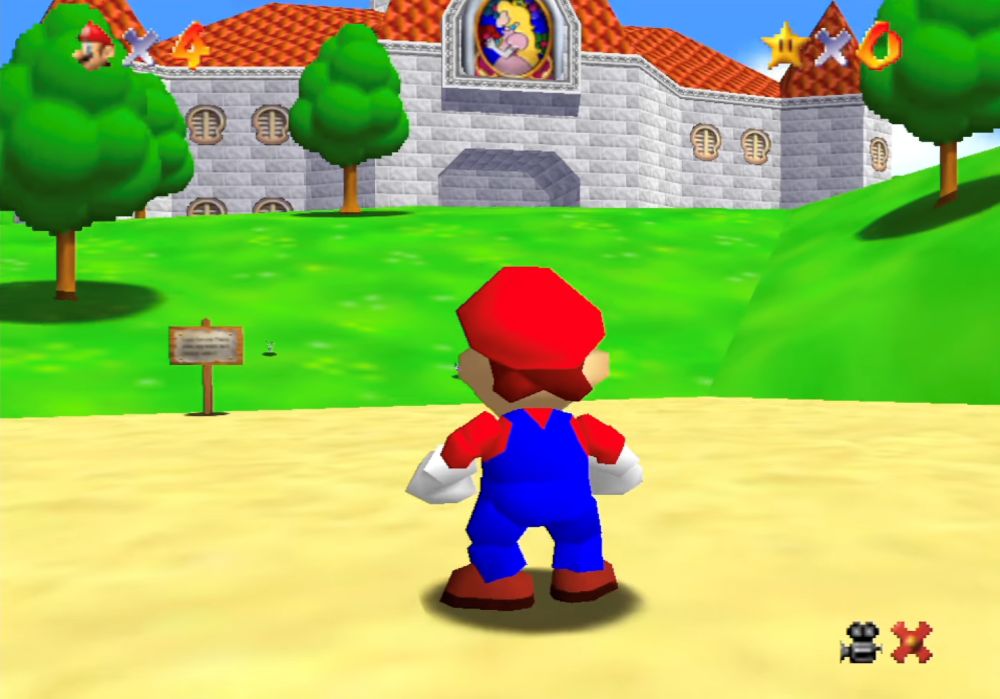
This is, in part, possible because SM64 – unlike so many other Mario titles – begins not in a Stage 1 littered with enemies and obstacles, but in a wide-open space, the gardens of Princess Peach’s Castle, which players are free to explore at leisure. It’s a deliberate choice, director Shigeru Miyamoto cognizant of the importance, at the time of SM64’s 1996 release, of acclimatizing players to Mario’s brand-new three-dimensional environs, here on the just-released Nintendo 64.
But even if Miyamoto hadn’t set it up this way, it’s safe to say we’d goof around anyway.
That’s because Mario – specifically, this Mario, the star of Super Mario 64 – is just so much fun to control, with a wealth of actions – a backflip, a double jump, a triple jump, a butt-stomp, so much more – which reward the curious player, and which eventually prove vital to tackling the game’s many and wildly varied challenges.
Testing these moves out, combining them, exploring various points of interest (for example, a sealed cannon in the courtyard, which in theory only unlocks after you’ve beaten the game), it’s easy to lose yourself in SM64’s opening, not even realizing there’s a whole castle interior to explore.
More to the point, Mario’s control scheme – the stuff you mostly figure out for yourself while frolicking about the courtyard – exemplifies something else about this now thirty-year-old masterpiece. Which is: its sly, improvisational spirit, the ragged edges (both deliberate and not) which generate a sense of freedom, of possibility, unparalleled in gaming.
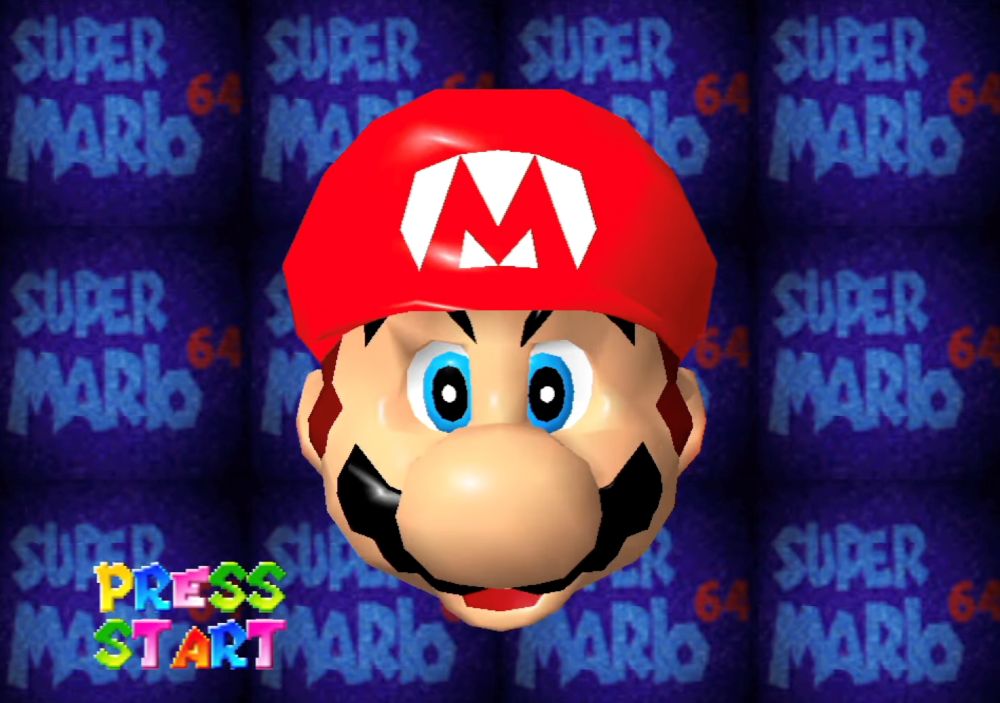
Everyone knows the story.
The little Italian plumber, known only as Jumpman at his 1981 debut in Donkey Kong, who quickly became the turtle-stomping, platform-leaping mascot for not just Nintendo but videogaming as a whole.
Super Mario Bros. (1985) remains a justly celebrated masterpiece to this day. Its immediate sequels – the offbeat Super Mario Bros. 2 (1988, in fact a hasty reskin of a wholly unrelated Japan-exclusive, Yume Kōjō: Doki Doki Panic) and Super Mario Bros. 3 (also released 1988) – each impressive in their own way, even as the next-gen Super Mario World (1990, Super Nintendo) solidified the template for the 2D platformer while ushering in a whole new era of bright, beautiful 16-bit graphics.
Then Super Mario 64, followed by Super Mario Sunshine (2002, the black sheep of the family), Super Mario Galaxy and Galaxy 2 (2007/2010) – together the two games which come closest to the SM64 spirit – and finally, the most recent entry in the canonical Mario platformers, 2017’s Super Mario Odyssey. (This, not to discount the many wonderful games which technically count as side entries, including the entire “New” series, the 3D World games, and the recentish Bowser’s Fury.)
But to return to the singular moment that is Super Mario 64, the game which released day-and-date (June 23, 1996) with the era-defining Nintendo 64, what remains so impressive about SM64 is how, in hindsight, it represents arguably the last moment when Nintendo truly allowed Mario to cut loose.
Partly, that’s because Miyamoto and team were learning as they went along, their free-for-all spirit infecting the game’s design, its willingness to push boundaries, test the limits of the new 3D space they (and we) were playing in.
Partly it’s also because, in so doing, Nintendo delivered an inherently flawed product. Not flawed in the sense of bad, but in the sense that, for all its bells and whistles, Super Mario 64 is overflowing with elements ripe for exploitation by the curious or bored player.
Whether it’s the jagged or incomplete level design which can, fairly easily, be glitched through, or the freewheeling mission structure which can be shortcutted, cheated, or just messed with for fun, SM64 represents the most fun you’ll ever have pushing against a game’s limits. (Surely Davey Wreden and William Pugh, creators of the delightfully fourth-wall-breaking The Stanley Parable, had Super Mario 64 in mind.)
Most of all, SM64 represents a bygone era of game design, an era in which focus testing, microtransacting, handholding, corporate synergizing hadn’t yet come to dominate creative decision-making.
Nothing about Super Mario 64 feels clean, tidy, pristine – and it’s all the better for it.
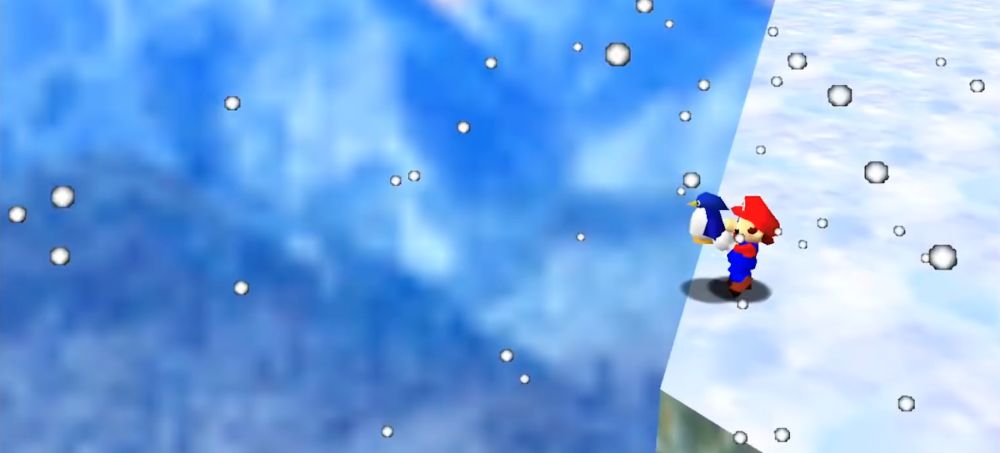
Case in point: SM64’s infamous dead baby penguin.
Gamers of a certain vintage will recall with morbid delight the moment they discovered that SM64’s fourth stage, “Cool, Cool Mountain”, places no restrictions on where you can take the adorable baby penguin you’ve been tasked with rescuing.
Up to that point, interactions with NPCs (non-player-characters) in SM64 had been relatively limited. There’s an early race against Koopa the Quick (easily beaten with one of the game’s many built-in shortcuts, which also serves the dual purpose of teaching players to look beyond the beaten path), there’s the friendly bob-ombs who operate the player-launching cannons, and there’s the Lakitu Bros., the mostly unseen camera operators shown briefly in the introduction, operating the in-game “cameras” which track the action. (A delightful conceit never repeated, to my knowledge, in any video game since.)
“Cool, Cool Mountain” ups the ante by featuring one of the game’s more talkative NPCs, a Mother Penguin anxiously pleading with Mario to find her missing baby. Doing so rewards, as do most such tasks in SM64, a Power Star, one of 120 such collectibles obtainable across the game. (Side note: although only 70 Stars are required to access the final boss, the remaining 50 offer some of the game’s best challenges, not to mention opportunities to tease out the limits of SM64’s interlocking gameplay systems.)
Most players, upon locating the Baby Penguin – she’s honestly quite easy to find – will simply race back to Mama and collect their reward. Others, though, perhaps already accustomed to testing the game’s boundaries, will drag Baby around with them, all over the titular Mountain, seeing what kind of mischief they can get up to. Horrifyingly, players soon learn this extends to the ability to drop Baby Penguin – canonically named Tuxie – off the side of a cliff, plummeting to an off-screen, but assuredly horrible, demise. (Pro players know to do this after collecting their reward from Mama Penguin, just to complete the portrait of evil.)
In Tuxie’s fate, then, we encounter something practically unheard of in a Nintendo, let alone Super Mario, title. And it’s something which would not, indeed could not, happen today.
Back in 1996, someone at Nintendo – perhaps deliberately, perhaps not – failed to set guardrails around where Baby Penguin can go, how far Mario can throw her. (I like to think it’s deliberate, given how tantalizingly close Mama Penguin sits to the precipice.)
If this game was made (or remade) in 2026, you can be sure such restrictions would be in place. Perhaps the level design would prevent Mario from chucking Baby off the ledge. Perhaps the drop/throw animation would rebound off an invisible wall if you tried. Whatever the means, the Nintendo of 2026 – fine-tuned, focus-tested, controversy-averse – would find ways to prevent this sort of experimentation.
SM64 is, in fact, filled with dead penguin moments, whether it’s glitching your way into areas you’re not supposed to see, exploiting enemy AI to do silly things, or taking advantage of certain techniques – many of which unimaginable to the game’s designers – to hyperspeed your way through the normally 12-to-15-hour game.
And there are some great dead penguin moments in Super Mario 64.
You can, for instance, glitch your way into that courtyard cannon I mentioned earlier, gaining early access to a rooftop – and Yoshi cameo! – not meant for players until they’ve collected every Star. You can also, exploiting the game physics, kill the normally unkillable giant fish which hunts Mario on “Tiny, Huge Island”. How? By tricking it into beaching itself, of course.
Many of SM64’s best-known glitches have been discovered by the speedrunning community, who have found ways to skip scripted sequences, glitch through otherwise impenetrable walls, and, perhaps most significantly, abuse a technique known as the Backwards Long-Jump (BLJ) to blast through the game. Here’s a video of the current world record holder, suigi, deploying many of those techniques to complete the game in under fifteen minutes. (Another side note: as a self-declared Old, it pleases me greatly to note that many of today’s top speedrunners are Gen Z, born long after SM64’s heyday but embracing the joys of its evergreen gameplay.)
Incidentally, if you watch that video I linked above, you’ll see that not all speedrunning tricks involve glitching or taking advantage of programming flaws. Rather, players have learned, through a mix of Mario’s core move-set and some daring pathfinding – just check out suigi’s remarkable pattern of back- and sideways-flips – how to race their way across the game. SM64’s worlds weren’t necessarily designed with such exploits in mind, but the game was built in a way which makes them possible.
Back in 1991, Capcom’s Street Fighter II accidentally ushered in a new era of gaming after its developers discovered a bug which allowed players to rapidly stack attacks, inflicting extra damage on vulnerable opponents.
This function – what we now know as the fighting game “combo” – did not exist before Street Fighter II, and we only have it today because someone at Capcom realized how revolutionary their accidental new system would prove to be.
Fast-forward a few years, and Super Mario 64, a game of vastly different scope and remit, similarly demonstrated what could happen when bugs, glitches, oddities left in the game code, add to, rather than subtract from, the experience.
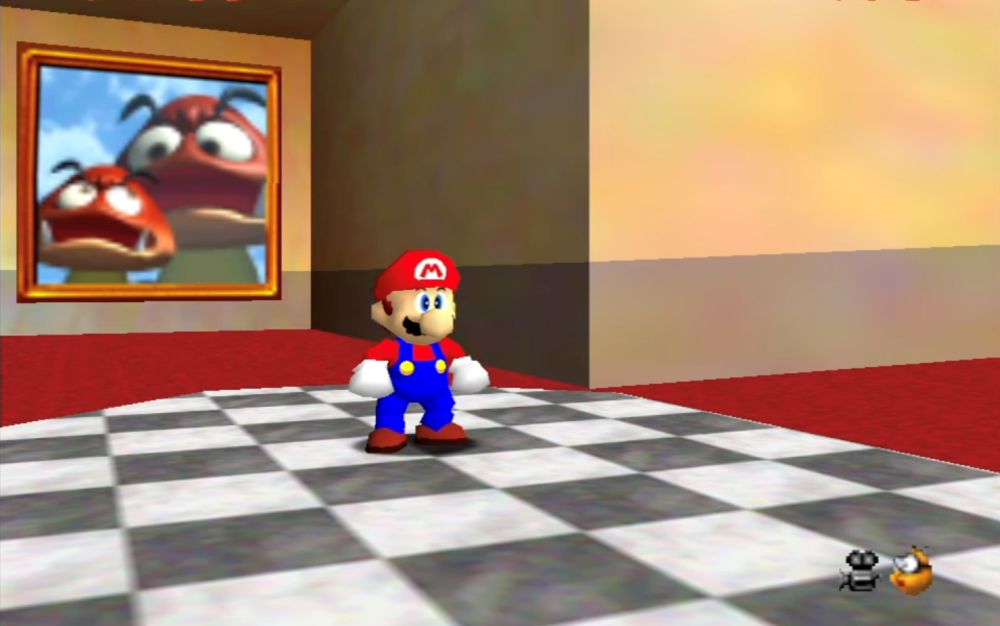
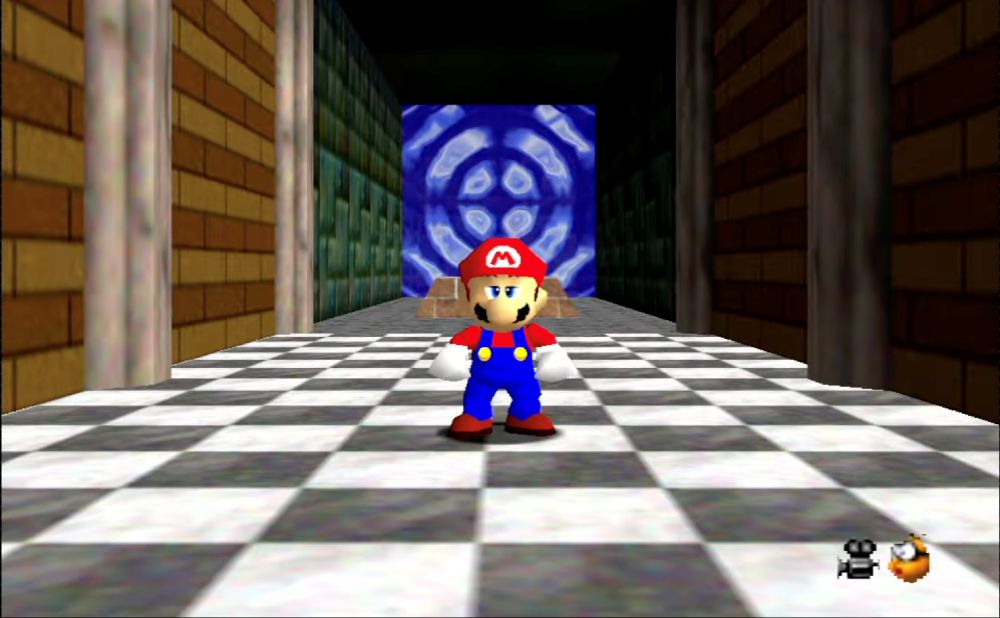
Super Mario 64 is, in one sense, broken. Even a novice player can do things, clip through glitchy level elements, that its designers almost certainly never intended. (The amount of time I spent backflipping my way up the steep hills of Bob-omb Battlefield, for example.) Spend any meaningful amount of time in SM64, and experimentation starts to come naturally – I am hardly the first player to look at “Bowser in the Dark World” and ask myself, why take the stairs?
I’m not saying those types of shortcuts aren’t available in, say, Super Mario Odyssey. But in that game, and in others of its (modern) ilk, they’re largely anticipated, by a team of designers who grew up on Super Mario 64, and who know what makes for a fun detour.
This, perhaps, is the core difference between the bygone era of SM64, when it was still up to ambitious players to carve their own path, and today’s modern, smoothed over games, in which every possibility – every wrong turn, every controversial choice – has already been accounted for and baked into the game’s design.
But getting back to the dead penguin: do I feel remorse over Trixie? Sure. Did I think it was funny? That, too. And if I interrogate why it was funny, it was by virtue of the very fact of its subversiveness, of the way it felt like I was breaking Nintendo’s rules.
Kid-friendly Nintendo is not supposed to let you drop a cute animal off a cliff.
Kid-friendly Nintendo is so afraid of offense that it transformed Mortal Kombat’s blood into gray “sweat” on the SNES. Sure, there are anomalies – hello, No More Heroes – but even in 2026 it’s rare to see Nintendo really put itself on the line, risk anything remotely tending towards controversy.
Back in 1996, however, Super Mario 64 broke free of all that, Miyamoto and friends – shoutout to assistant director Takashi Tezuka, who played such an important role in bringing SM64’s impeccably-designed stages to life – experimenting within the confines of the bespoke sixty-four-bit system which was in fact built with SM64 in mind.
In so doing, Nintendo created something singular, and essentially unreplicable. (Which is not to say there aren’t dead penguin-like exploits to be found in other games of the era, such as Miyamoto’s own Ocarina of Time and its endlessly exploitable item glitches, or the hilariously manipulable attributes system of The Elder Scrolls III: Morrowind.)
The dead baby penguin of Super Mario 64 is, in other words, indicative of something much bigger, something which has been lost. That is, the sense, rarely present in contemporary gaming, of an organic world, of a world that’s ripe for exploration, not on its terms – what the developers want you to do – but on your own, even if it means breaking the game wide open. (Perhaps the closest approximation is the recent Zelda games, though even those are so finely-honed that it’s rare to pull off any trick the game hasn’t already anticipated.)
The genius of Super Mario 64 is that it works, not in spite of but because of its broken frames and glitchy stairways, its impossible coins and its absent guardrails. It is a wonderful exemplar of a kind of design which no longer exists, a design which isn’t afraid of what players might do, of allowing them to peek behind the digital curtain.
There are no invisible walls in Super Mario 64, not really.
Instead, there are glitches to exploit, guardrails to barrel through, and a dizzying array of ideas generated by a man, Miyamoto, and a company, Nintendo, at the top of their game.
It is, in its own way, the perfect game of an imperfect era.
***
For more nostalgia-laden retrospectives, check out the Toronto Guardian’s Late to the Game series, where we try – for the first time – all those classic games we missed out on during their heyday.