
International superstar orchestra Budapest Festival Orchestra, under the baton of superstar conductor Iván Fischer, recently graced the Koerner Hall stage for an unmissable performance of Mahler’s epic Third Symphony. The Symphony No. 3 in D minor, completed in 1896, is one of the capital-g Great symphonies (it ranked tenth in a BBC conductors’ poll of all-time symphonies in 2016), a monumental work of extraordinary breadth and scope, and a runtime – nearly two hours – to match.
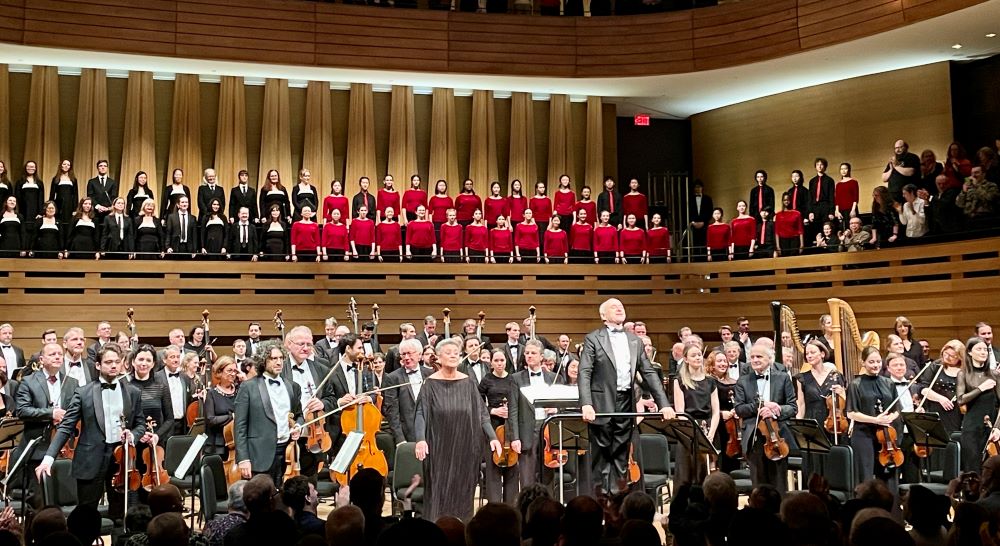
Hungarian conductor Iván Fischer is almost in a class of his own. Founder of the Budapest Festival Orchestra, and with long-running associations with essentially all the major orchestras (Los Angeles Philharmonic, London Symphony Orchestra, Vienna State Opera, etc.), any performance under the Fischer baton is guaranteed to be a success.
Thursday’s performance of Mahler’s Third was no exception. While the Koerner hall is perhaps a tad too small for the oversized symphony – and oversized orchestra, augmented with a children’s choir, adult choir, and soprano soloist – it was still a mesmerizing performance.
Everything about the Third is a marvel, beginning with its structure: two halves, in which the first half is a single movement (Kräftig. Entschieden, “Strong and decisive”) which is essentially a symphony unto itself. Following that incredible opening – the audience burst spontaneously into applause at its conclusion on Thursday night – the Symphony then moves into its second half, a full five additional movements.
Of the remaining movements, the fourth movement Sehr langsam—Misterioso (“Very slowly, mysteriously”) is probably the most fascinating, not only for its literary connections – it’s adapted from a portion of Nietschze’s Also sprach zarathustra, the same work which would later go on to inspire R. Strauss’s famed work – but for the introduction, after already more than an hour of music, of a solo voice. Here, mezzo-soprano Gerhild Romberger sings the lyrics of Nietzsche’s “O Mensch! Gib Acht!” (“O Man! Take heed!”) as select themes from the first half are woven throughout.
The highlight, however, is undoubtedly the majestic finale, the incredibly moving Langsam-Ruhevoll-Empfunden (“What Love Tells Me”). The experience of listening to this finale, coming not only after nearly an hour-and-a-half of music, but after an hour-and-a-half of already extraordinary music, is hard to put into words. I will say this, however: the soprano Romberger (who has no singing role during this movement) could be seen weeping, overwhelmed by the emotion and the power of Mahler’s music.
***
The Royal Conservatory of Music’s season continues throughout February – June 2026.