This year marks the fiftieth anniversary of the concluding chapter of the greatest trilogy in the history of Canadian literature.
Robertson Davies’s Deptford Trilogy, so named for the fictional village in which most (though, importantly, not all) of its action is situated, its three entries – Fifth Business (1970), The Manticore (1972), and World of Wonders (1975 Canada/1976 Worldwide) – represent the high watermark of the extraordinary career of Toronto’s own Davies, a work which is both quintessentially Canadian and yet universal.
And please, don’t let its perennial status on high school reading lists fool you, the Deptford Trilogy is a masterpiece, and the work you should be reading this Canada Day.
When people ask about my favourite authors, I typically reply that that’s both an impossible question, but also here’s my holy trinity: Charles Dickens, Robertson Davies, John Irving.
Dickens is, of course, the master of the sentimental novel, an author who paired an earnest love for humanity (especially children) with a social critic’s eye for injustice. Like Zola (who might be my fourth, if pressed to form a quartet), Dickens knew how to tell a story, tell it well, and tell it in a way that also revealed something essential about the human condition, even and especially in the face of the unfair systems that govern our dysfunctional society.
Dickens’s best novels are all, or nearly all, bildungsromans, typically stories of a boy/young man’s journey through adversity (David Copperfield, Great Expectations), though he could also write wonderful, if somewhat idealized, female protagonists, as in Hard Times’s Louisa Gradgrind or Esther Summerson of Bleak House. The worlds of Dickens are elaborate, colourful, lived-in, with memorable casts of characters, even minor ones, that stick with you long after you’ve set those worlds aside.
Writing almost precisely a century later (Davies was born 1913; Dickens 1812), Robertson Davies was not a social critic in the vein of Dickens, but he was, in his own way, a master worldbuilder, his novels similarly populated with extraordinary people (men and women, though, like Dickens, he favoured male protagonists) pushing against the boundaries of their time and place, and evolving in interesting and unexpected ways.
Like Dickens, Davies was also something of a serial storyteller: where Dickens published his stories across months or even years in the pages of magazines or journals, Davies’s novels were nearly all published in trilogy format: in addition to Deptford, there are Salterton, Cornish, and even an unfinished Toronto trilogy (the finale not yet completed at the time of Davies’s death).
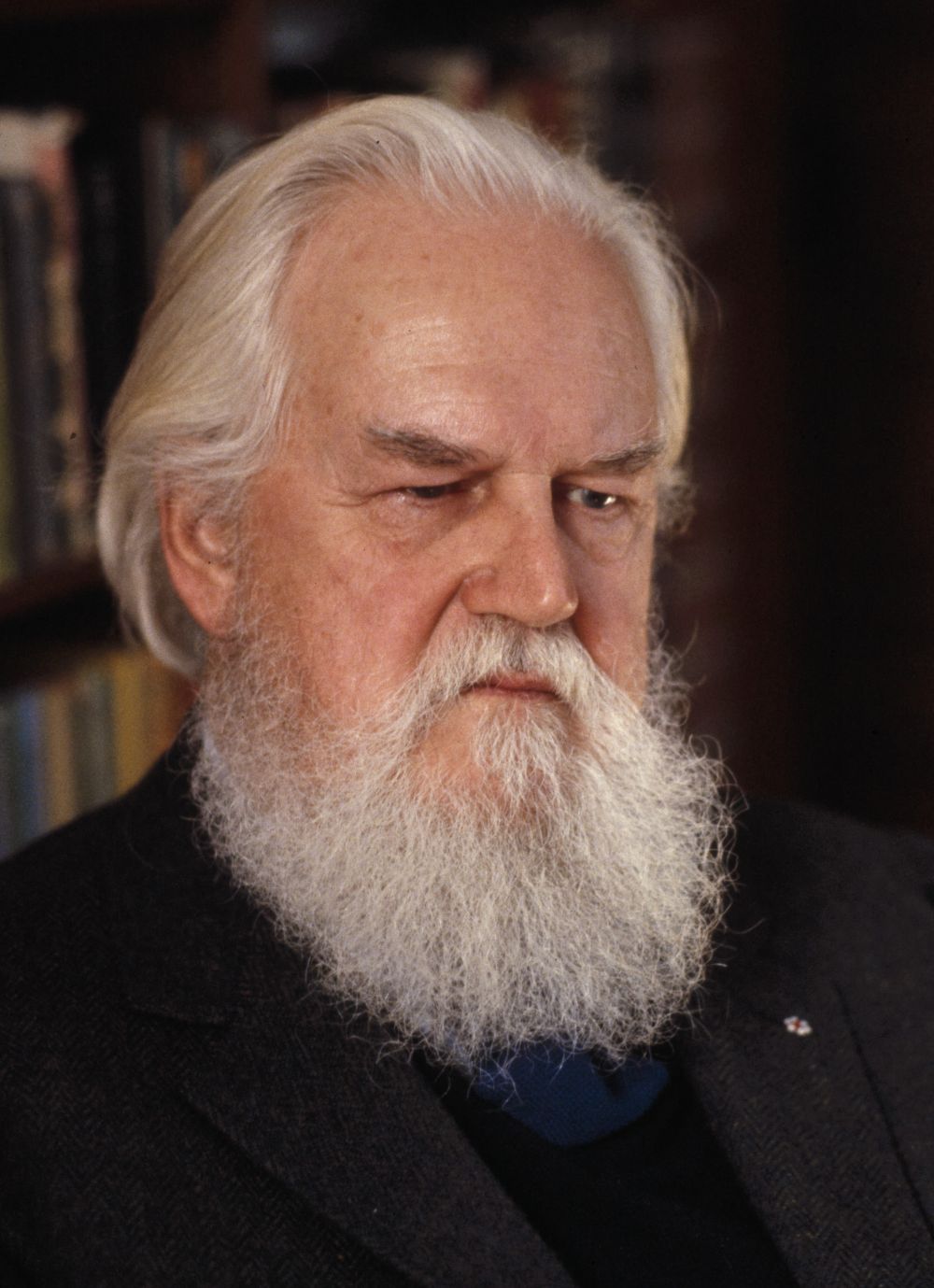
Widely and affectionately known as Canada’s Santa Claus, with his great white beard and tall, heavyset figure, Davies was also, as John Irving referred to him, “Canada’s Dickens”.
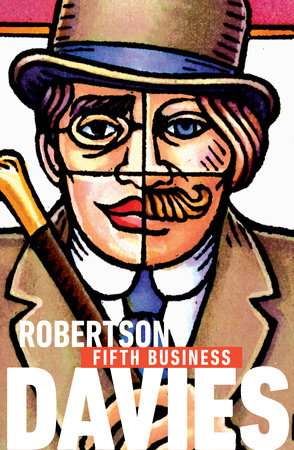
Which brings us to The Deptford Trilogy, of which Fifth Business remains (arguably to its detriment) the best-known entry, by virtue of its perennial placement on mandatory high school reading lists.
In some ways, it helps to start with what the Deptford Trilogy is not.
It is not, despite the best efforts of your high school English teacher, a hyper-local maple-boned tale about the small lives of small people in a small town (Deptford inspired by Davies’s own hometown of Thamesville, in southwestern Ontario). It is also (despite the previous parenthetical) not an autobiographical or semi-autobiographical account of Davies’s own life, a reductive take which misses the point of this magical realist masterpiece.
What it is, however, is a stunning trilogy of interconnected lives and experiences, each entry wildly different from the others, yet all threaded together with the deft touch of a master storyteller who has clearly studied his Dickens.
The first novel, 1970’s Fifth Business, is easily the most grounded. An epistolary novel, it takes the form of an extended letter from its narrator, Dunstan/Dunstable Ramsay, recounting the events of his life, ranging from a smalltown upbringing to traumatic – and magical realist – experiences in the First World War, through an intriguing detour to Mexico, before finally settling in as history teacher at Colborne College (yet another stand-in, inspired by both Upper Canada College, which Davies attended, and University of Toronto’s Trinity College, where he taught literature for over twenty years).
Beginning, amusingly, with an invented quote which purports to define the titular phrase – “those roles which, being neither those of Hero nor Heroine, Confidante nor Villain, but which were none the less essential to bring about the Recognition or the denouement” – Fifth Business is a novel of cause and effect, focussing on the consequences of a single action, an inciting incident which profoundly affects the lives of those involved.
Here, that incident is of a particularly Canadian bent, a missed snowball throw – aimed at Ramsay but instead hitting the young preacher’s wife Mary Dempster, sending her into premature labour. Mary’s premature son, Paul Dempster, will appear as a central figure across the trilogy, while it’s David Staunton, who is the son of the snowball thrower (Percy Boyd Staunton), who takes centre stage in the second, and easily most experimental novel, The Manticore. Sons play a very important role in the Deptford Trilogy.
In Fifth Business, however, it’s the man on the sidelines of those sons’ stories who takes centre stage. Ramsay’s guilt over ducking from that snowball haunts him throughout the novel, even as his experiences in World War I – in the novel’s most memorable scene, an ailing Ramsay is struck by a vision of an amalgam of the Virgin Mary and the pointedly-named Mary Dempster – and, later, with the grown-up snowball-thrower, Percy “Boy” Staunton, convince Ramsay there are strange spiritual forces at work around him.
Narrative detours – studying the saints alongside a brotherhood of Jesuits; befriending a mysterious magician and his androgynous partner in Mexico – which would read as eccentric or contrived in the hands of a lesser writer, only add to the general feeling of instability, of Ramsay’s world being guided by some strange, mystical force.
Inevitably, as in any of the great Dickens novels, these serpentine paths eventually converge, as characters, plotlines, even objects come together, neatly tying together a story which, across its two-hundred-fifty or so pages, constantly and enthusiastically drifts off in unpredictable directions. The finale, which offers significant resolutions even as it ends on a note of ambiguity which tees up the second novel, is a highlight.
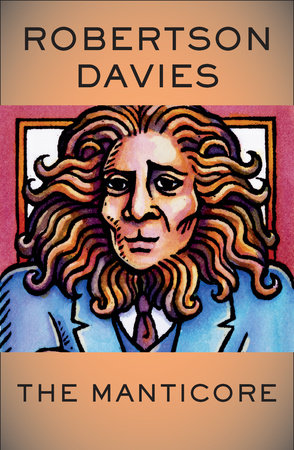
Like many a middle entry, follow-up novel The Manticore is darker than the works on either side of it. It’s also the most experimental, spurred on by Davies’s fascination with the works, and psychoanalytical methods, of Swiss psychologist Carl Jung.
A Jungian novel in the truest sense – it takes place largely within the confines of an extended therapy session – Manticore does not so much as pick up from where Fifth Business left off, as unspool yet another one of its many threads, tying all the way back to that inciting snowball incident. This time, however, the protagonist is David Staunton, son of the original snowball-thrower, who we follow here as he attempts to unravel the mysteries of his own and his father’s lives.
The title, a reference to the chimeric creature with the face of a human, body of a lion, and tail of a scorpion, gives some of an idea of the space Davies is working in. There are ruminations on the collective unconscious, dream-meaning, and shifting identities. Also, several returning characters, including Dunstan Ramsay, the ever-mysterious magician Magnus Eisengrim, and several others with connections to Deptford. Amusingly, one of the unspoken themes of the Deptford Trilogy is that even a forgotten village in rural Ontario can exert a gravitational pull that spans the globe.
While on the one hand the novel does resolve some of the lingering mysteries of its predecessor, The Manticore is just as interested in telling a wholly new story, one in which David Staunton – alcoholic, depressed, scion of a wealthy family – proves to be perhaps even more compelling a protagonist than Ramsay before him. I am no Jungian, so I can’t honestly speak to how effectively this works as an application of the great psychoanalyst’s theories, but I can say that, as a story, it’s a compelling one. By weaving together the dream-world of Jung with the mysticism already present in the previous novel, Davies creates a slightly unsettling, destabilizing world, in which everything, especially memory, is open to interpretation and interrogation.
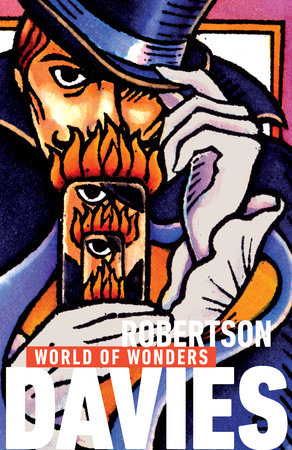
The best conclusions are those which both offer readers some form of closure, while still leaving their worlds intact, characters left to live and breathe throughout the unseen days and weeks and years to follow.
Davies’s World of Wonders is not a perfect finale, but it does a wonderful job of tying together the many disparate threads of a trilogy which begins with a small-town accident and explodes out into a whole universe of magic, religion, wars, corruption, violence.
Here, in World of Wonders, Davies gives us what we’ve longed for all along without really knowing it: the story of Magnus Eisengrim, the mysterious magician who’s floated his way through the previous two novels.
Because World is a book of revelation, it’s very difficult to discuss it here without giving away some of its most poignant secrets. Nevertheless, it’s safe to say that Eisengrim (explicitly a pseudonym from the first) is someone who’s hovered in the margins of the entire trilogy, dating right back to that initial snowball fight. He’s a Deptfordian – because of course he is – and a deep admirer of Jean-Eugène Robert-Houdin, the magician who inspired Harry Houdini, that master of illusion and reinvented identity. (Incidentally, this makes Eisengrim an indirect literary predecessor to Michael Chabon’s Sammy Clay. I have no evidence, but I’d like to think Chabon was inspired by World of Wonders while writing his masterpiece, The Amazing Adventures of Kavalier and Clay.)
Eisengrim is also, like Dunstan Ramsay and David Staunton before him, an instrument through which Davies contemplates something of what it means to be human – and, in particular, what it means to build human connections. Eisengrim may be an illusionist extraordinaire, with endless pseudonyms and half-truths for backstory, but he’s also a man with a very specific origin, one which keys into and, eventually, offers an alternative perspective to the moments, characters, revelations of the preceding novels. It’s no small act of literary bravery to use your third novel to retroactively interrogate the things which your readers have come to accept and rely upon, but Davies pulls this off with aplomb.

It’s impossible to discuss Davies without also talking about John Irving. If Dickens and Davies are the Father and the Holy Spirit (I’ll leave it to you to decide which is which), then Irving is the Son.
The Academy Award-winning author of The Cider House Rules and The World According to Garp, Irving was born and raised in Exeter, New Hampshire, and situates many of his novels in that New England milieu. An oft-overlooked aspect of Irving’s story, however, is his deep and abiding love for Canada, where he now resides, and how Robertson Davies brought him here.
As Irving is fond to relate, he instantly fell in love with Davies after encouraging his works as a young man. Then, after Davies wrote a laudatory review of Irving’s fifth’s novel, The Hotel New Hampshire (1981), Irving reached out, the two quickly becoming fond pen pals before Irving, on a whim, journeyed up to Toronto for the sole purpose of meeting his literary hero.
Soon enough, a strong and abiding friendship developed, the writers bonding over their shared admiration of Dickens. By 1987, Davies would appear as one of the readers at Irving’s wedding (to Canadian literary agent Janet Turnbull); in 1995, Irving spoke at Davies’s funeral. In 2015, after years of shuttling back and forth between his beloved New England and Toronto, Irving finally took up permanent residence here, becoming a Canadian citizen in 2019. In a 2022 interview, Irving said, “The first Canadian to open my eyes was Robertson Davies.”
While Irving has countless fans, it’s doubtful how many are aware of Irving’s Canadian connection, and, in particular, the fact that Irving’s A Prayer For Owen Meany – as it happens, this critic’s favourite Irving – is an explicit homage to Davies. To be even more precise, it is a pastiche of the Deptford Trilogy.
The parallels are impossible to ignore.
Owen Meany’s narrator is a teacher at a private school in Toronto; he’s spent his life as fifth business to the titular Owen Meany, a preternaturally small child who, like Paul Dempster, was born premature under unusual circumstances. Owen Meany has less magic than the Davies trilogy, though it does have a healthy religious streak, particularly in its treatment of the strangely angelic Owen and the Mary-like figure of Owen’s mother, who insists that Owen’s was a virgin birth. Owen Meany even has an inciting childhood incident – here, an errant foul ball which kills a young mother – which Irving liberally borrowed from the ill-fated Deptford snowball.
Irving is, today, the better-known author. An award-winner (though, somewhat surprisingly, he’s never won the Pulitzer – I had to triple-check), his works have sold in the millions, with film adaptations which themselves have earned millions at the box office. Ever since he became a Canadian citizen, he easily ranks among the most beloved Canadian literary figures, sitting comfortably alongside Davies, Margaret Atwood, Irving Layton, and Leonard Cohen.
Irving is also, at eighty years old, the proud torchbearer for what’s arguably an unfashionable literary tradition: tales of humanity, of our capacity for compassion and for love, in the mode of Davies and, before that, Dickens.
Irving tells a wonderful story, about Davies’s guest-starring appearance at Irving’s wedding:
“My two sons from my first marriage, Colin and Brendan, were the best men. They had not met Rob before the wedding, and Brendan – he was 17 at the time – didn’t see Professor Davies, in his magnificent white beard, approach the pulpit. Brendan looked up and, suddenly, there was this big man with a big beard and a bigger voice. Colin, who was 22, told me that Brendan looked as if he’d seen a ghost. But Brendan, who was not overly familiar with churches of any kind, had had a different thought.
Brendan was quite certain that Professor Davies was God.”
If Davies was a god, then he was a benevolent one, creating, in his fictional worlds, a space to explore what it means to be human, to wrestle with one’s faith, to decide how to define, and redefine, oneself as circumstances require.
The Deptford Trilogy, his masterpiece, is the great Canadian literary trilogy, one which we happily celebrate this day of national pride.
***
The Deptford Trilogy is published today through Penguin Random House Canada, and can be found at The Scribe, BMV, or whatever independent bookstore you frequent.