
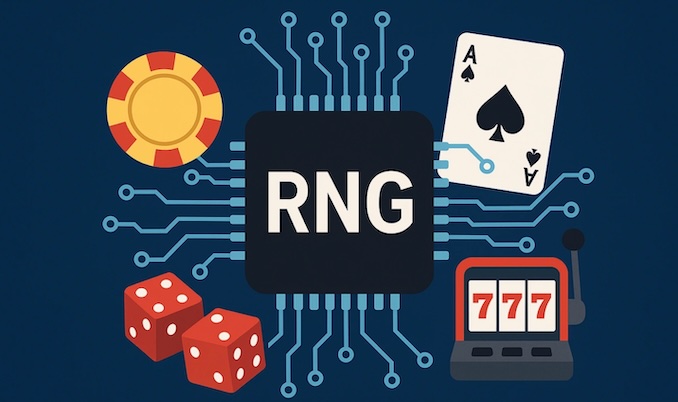
Online casino games may look visual and interactive, but every result begins with a number generated in a fraction of a second. When a player spins a slot, draws a card, or places a roulette bet, the outcome is already determined by a system working behind the interface. This system is called a random number generator, or RNG, and it produces sequences that decide what appears on the screen. Players often see only the animation, while the actual decision happens instantly in the background. That gap between what you see and what actually determines the result leads to many misunderstandings.
The Technology Behind RNG Systems
Modern casino software relies on pseudorandom number generators built on deterministic algorithms that produce sequences statistically indistinguishable from true random behavior. In simple terms, the system follows strict rules, yet the results appear unpredictable even under detailed analysis. One of the most commonly used algorithms is the Mersenne Twister, introduced by Makoto Matsumoto and Takuji Nishimura in 1997. It operates over a 19,937-bit state space, which allows it to generate an extremely long sequence before repeating. Practically speaking, the sequence is so long that repetition will not occur during any realistic gameplay session, even if the system runs continuously for years. Every RNG sequence begins with a seed, an initial value that defines all subsequent outputs. This seed comes from constantly changing inputs such as nanosecond-level timestamps, minor hardware fluctuations, and system activity. These inputs shift every fraction of a second, which makes recreating the same starting point almost impossible. Once the seed is set, the generator produces thousands of numbers per second in a continuous stream, regardless of whether anyone is playing at that moment. That means the system does not “wait” for a player – it is always running in the background.
When a player interacts with a game, the system takes one number from that stream at a precise instant and translates it into a result. For example, a slot game may use a number between 0 and 999,999 and divide that range into sections that correspond to reel positions. If the number falls into a specific segment, it determines exactly which symbols appear. This translation step is what turns raw numbers into something visible on the screen. While the process involves several layers of calculation, it happens instantly and without any visible delay. If you want to observe how these number-to-outcome mappings behave in actual gameplay sessions, Ludios Casino is a good place to start when exploring RNG-driven games from a user perspective. In that context, each spin reflects a single captured value from a continuously running sequence rather than a calculated response to player behavior. That detail explains why outcomes remain independent, even when results appear to form short-term patterns.
How RNG Determines Outcomes in Different Games
Every game type in an online casino draws on the same underlying RNG engine, but each interprets the output differently depending on its rules and pay structure. In slot games, the RNG number maps to a virtual reel strip. Physical slot machines had 20 or 22 stops per reel. Digital slots can have hundreds of virtual positions per reel, with high-value symbols mapped to far fewer stops than low-value ones. The probability of a jackpot combination is therefore not a matter of luck in the traditional sense – it is the ratio of jackpot-mapped numbers to the total number space, calculated precisely by the software before the game ever ships. In online roulette, the RNG produces a number that maps directly to one of 37 or 38 wheel positions (depending on whether it is European or American format). The algorithm generates the result the instant the ball is released in the animation, the spinning visuals are purely cosmetic, running in parallel with an already determined outcome. The number-to-pocket mapping is a straightforward modular division: the output modulo 37 gives a value from 0 to 36. In card games such as blackjack, baccarat, or video poker, the RNG drives a virtual shuffle algorithm. At the start of each hand or shoe, the engine uses a Fisher-Yates shuffle, a method that generates a full random permutation of the deck by iterating through positions and swapping each card with a randomly selected earlier position. This produces a statistically valid shuffle equivalent to a perfectly randomized physical deck, with no card position influenced by any previous shuffle.

Why RNG Ensures Fairness (and What It Doesn’t Do)
The most important statistical property of a properly implemented RNG is independence between outcomes. Each number generated is mathematically unrelated to the one before it or the one after it. A slot that has not paid out in 400 spins is not “due” – the 401st spin has the exact same probability of winning as the first spin of the session. This is not a philosophical position – it is a mathematical fact about how the sequences are constructed. Casino operators do not control individual outcomes after the RNG is deployed. The software runs the algorithm, while the casino configures the pay table and RTP percentage, which influence long-run averages – not specific spins. A casino cannot decide that a specific session should lose, nor can it trigger a win to keep a player engaged. What it controls is the house edge baked into the game’s mathematics, which operates over millions of hands or spins and is entirely separate from moment-to-moment randomness. There is also no “memory” in the system. The RNG does not know your deposit total, your session duration, or your last ten outcomes. These are meaningless inputs to an algorithm that only tracks its own internal state, derived from mathematical operations on the current number in the sequence.
Testing and Certification of RNG Systems
Because players cannot audit the code running inside casino software, independent testing laboratories fill that role. The two most prominent global certifiers are eCOGRA (e-Commerce Online Gaming Regulation and Assurance), based in London, and iTech Labs, an accredited ISO/IEC 17025 laboratory based in Australia. Both organizations receive the RNG source code, implementation, and documentation from casino software providers and run a battery of statistical tests, including the NIST SP 800-22 suite, which was originally developed for cryptographic applications and tests for frequency, block frequency, runs, spectral characteristics, and serial independence.
The audit process does not end at initial certification. Reputable testing bodies conduct periodic re-audits and ongoing monitoring of deployed games, checking that the live software matches the certified version. Casinos displaying eCOGRA or iTech Labs seals are contractually obligated to maintain that certified code in production without unauthorized modifications. Regulatory bodies in jurisdictions such as Malta (MGA), the United Kingdom (UKGC), and Gibraltar require third-party RNG certification as a condition of licensing.
Common Misconceptions About RNG
Perhaps the most persistent myth in online gambling is the concept of “hot” and “cold” slots. A “hot” slot is supposedly one that is paying out frequently and will continue to do so, a “cold” slot is overdue for a win. Neither characterization reflects how RNG functions. Because each spin is independent, a machine’s recent payout history carries zero predictive value. Casinos have no mechanism to cool down a paying machine mid-session, and players have no mechanism to exploit recent patterns because none exist.
A second category of misinformation involves “RNG strategies,” betting systems or timing methods claimed to predict or influence the sequence. Since the RNG produces thousands of numbers per second regardless of player activity, and the game captures whatever value exists at the exact millisecond of your action, any attempt to “time” a spin is operating on nanosecond-scale precision that human reaction times cannot approach. Betting systems such as Martingale or Fibonacci affect bankroll management only, and they have no mathematical relationship to the RNG output.
The claim that casinos “rig” specific outcomes for individual players is theoretically possible with unverified software, which is precisely why third-party certification exists. A certified and audited platform provides algorithmic evidence that no post-deployment tampering has occurred.
RNG vs RTP and Volatility
These three concepts are frequently conflated, but they operate at different layers of a game’s design. The RNG determines which specific outcomes occur on any given spin or hand, and it is a real-time process. RTP (Return to Player) is a theoretical long-run average: a 96% RTP means that for every $100 wagered across millions of rounds, the game is mathematically designed to pay back $96. RTP says nothing about what happens in your 50-spin session – it describes aggregate behavior over a sample size in the tens of millions. Volatility (also called variance) describes the distribution of those payouts. A low-volatility game pays small amounts frequently, a high-volatility game pays larger amounts rarely. Both can have identical RTP values. The RNG generates outcomes that are consistent with both the RTP and the volatility profile the developer programmed into the pay table. A player who understands all three can make informed decisions about their bankroll: high-volatility games require larger reserves to sustain losing runs before a significant win materializes.
How a Slot Spin Works
- The player presses the spin button, triggering the game’s action handler at a precise system timestamp.
- The RNG algorithm captures the number currently active in its ongoing sequence at that millisecond.
- Each reel receives a separate mapped value from the sequence, translating the raw number into a specific symbol position on the virtual reel strip.
- The game engine compares the resulting symbol combination against the pay table to determine whether it constitutes a win, a bonus trigger, or a no-win result.
- The visual animation plays out, synchronized with the already determined outcome stored in memory.
Key Concepts at a Glance
|
Term |
Meaning |
Why It Matters |
|
RNG |
Algorithm generating unpredictable number sequences thousands of times per second |
The mechanism behind every game result, determines what each spin, draw, or roll produces |
|
RTP |
Long-run theoretical payout percentage programmed into the pay table |
Describes average returns over millions of rounds, not session-level results |
|
Volatility |
Statistical spread of payout frequency and size |
Determines how frequently wins occur and how large they tend to be, affects bankroll requirements |
|
Seed |
Initial value used to start the RNG sequence |
Derived from environmental entropy, cannot be predicted or reproduced |
|
Certification |
Third-party audit confirming the RNG matches statistical standards |
The only verifiable evidence a player has that outcomes are genuinely unpredictable |
The key takeaway is simple: the more you understand about how thoroughly randomized certified RNG systems actually are, the less useful any in-session observation becomes. Past outcomes, streak counts, and timing patterns are artifacts of human pattern recognition applied to a system specifically designed to defeat it. Choosing certified platforms and understanding RTP and volatility gives players the only real analytical leverage available.
