
The Game: Spider-Man 2: Enter: Electro (2001)
Original Platform: Sony PlayStation
Version We Played: Sony PlayStation
Verdict: Well it sure as hell ain’t The Godfather Part II.
Nobody would mistake the egregiously hyphenated Spider-Man 2: Enter: Electro for a classic.
But it is the sequel to one of the great comic book video games, and for that it deserves our attention.
In retrospect, it’s somewhat surprising we missed it at release, back during the era of Peak PlayStation. Though, in our defence, 2001 was also the year of Gran Turismo 3, and Grand Theft Auto III, and Metal Gear Solid 2: Sons of Liberty, and Tony Hawk’s Pro Skater 3, and, oh, wow, that’s quite a list…
Enter: Electro is not a good video game.
But it’s also not a good Spider-Man game, or even a good late-PS1 game. It’s generic trash, sullied by repetitive missions, an unfortunate fixation on timer-based challenges with insta-fail conditions, and a lackluster storyline which picks up in the immediate aftermath of the 2000 Spider-Man game, and proceeds to do absolutely nothing interesting with it.
Enter: Electro is easily the worst video game I played this year, and for once, being late to the game was absolutely, embarrassingly, not worth it. Apologies, PSM Magazine #51, I should’ve listened.
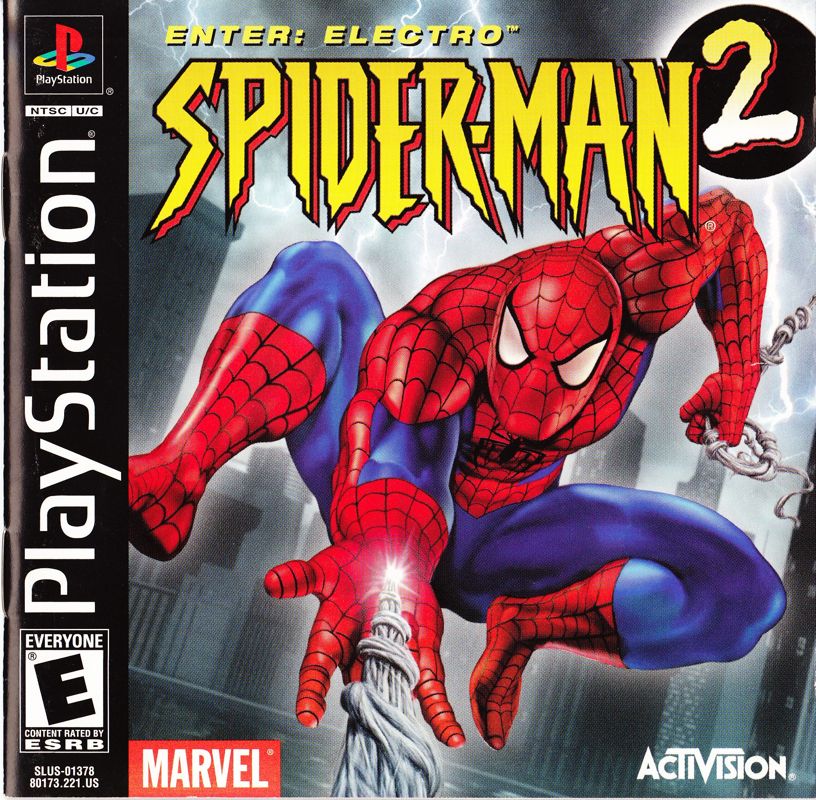
LIFE STORY
The original Spider-Man (2000) is a comic book gaming masterpiece.
Developed by Neversoft, of Tony Hawk’s Pro Skater fame, it wedded excellent gameplay with comic book-faithful storytelling, including an incredible cross-section of Marvel heroes and villains alike (Spider-Man PS1 thrives on cameos).
Anchored by excellent voice performances from the likes of Canadian actor Rino Romano (reprising his titular role from TV’s Spider-Man Unlimited), future femShep Jennifer Hale (reprising Black Cat from the 1990s Spider-Man cartoon), and journeyman voice actor Daran Norris (who voices the majority of the game’s villains and guest heroes), it’s a joy to play, and engaging from start to finish.
Oh, and don’t forget the Stan Lee of it all, with Stan the Man Himself narrating both the main narrative and the delightful, Easter Egg-laden “What If?” mode, which plays as a funkier, funnier alternate take on the game’s story. (And represents the rare “New Game+” mode I recommend unequivocally.)
Spider-Man 2, developed by Vicarious Visions (best known, not coincidentally, for the excellent GameBoy Advance ports of Neversoft’s Tony Hawk games), had a lot to live up to.
Poor Spider-Man 2.
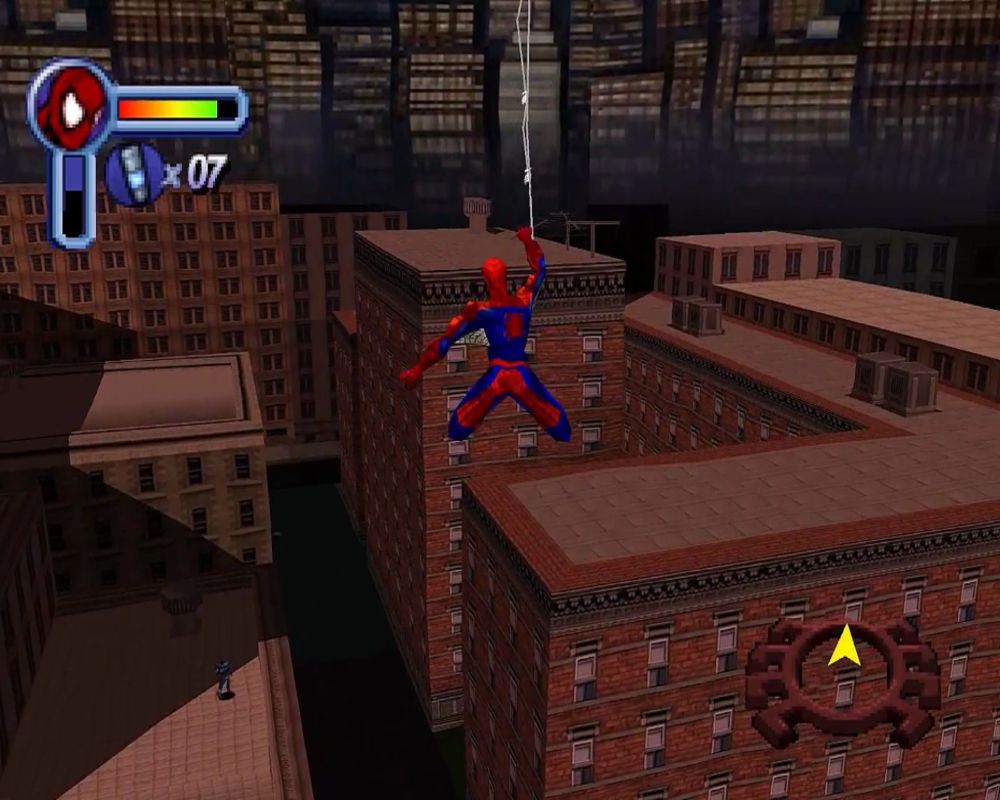
SPIDER-MAN NO MORE
Now, in fairness, and as we’ve written before, there’s only so much blame to be laid on a gun-for-hire studio suffering under an unfair, producer-mandated, timeline.
Neversoft’s Spider-Man released in August 2000, and Vicarious Visions was brought on shortly after in order to churn out a sequel as quickly as possible, the game slated for release in September 2001. Though it was eventually delayed about a month (for reasons we’ll get into below), it was never going to match the heights, so to speak, of its predecessor. (Incidentally, Neversoft’s next game? A little something called Tony Hawk’s Pro Skater 3.)
But let’s begin with the good: gameplay in Enter: Electro is strong, largely hewing to its predecessor, with only slight tweaks here and there. Spider-Man jumps, swings, and punches and kicks smoothly, and a healthy distribution of med-kits and web cartridges means you’re rarely starved for resources.
The voice acting (Romano et al returning from the previous game) is also quite good, and that includes yet another Stan Lee narration, if more perfunctory than his work in the 2000 Spider-Man. Some of the missions are fun – there’s a hostage rescue mission “borrowed” from the previous game; Enter: Electro introduces the ability to leap from skyscrapers down to ground level in certain stages, which wasn’t possible in the first game – and it’s neat to encounter 90s’ified versions of lesser-known characters like Electro, Hammerhead, and Beetle (not to mention several X-Men cameos).
It’s no Arkham City or Insomniac’s Spider-Man, but it plays well enough.
Though not if you have to sit with it for a while.
Spend more than a couple hours with Enter: Electro (the game only takes about seven hours to complete), and the frustrations begin to mount.
There’s the dull (and oddly repetitive) enemy design. The controls, which are somehow both more complicated and less responsive than in the prior game.
The story is disappointingly bland, lacking both the interesting twists and turns of its predecessor (the – spoilers at link – villain “team-up” in the PS1 Spider-Man is certainly one for the ages), and failing to build meaningfully on the notion this is supposed to take place in the hours and days immediately following the previous game.
Most of all, though, Spider-Man 2: Enter: Electro is a mean bastard of a video game.
BACK IN BLACK
I lost track of the number of times I died because the camera randomly spun the wrong direction. I lost track of the number of times I encountered a timer-based boss who moved faster than my thumbs. I lost track of the number of times I (almost) threw my controller across the room.
Let’s consider some of the worst offenders.
There’s the bomb mission, in which you must locate four keys in a fairly well-realized cityscape, before a timer goes off. As will become a theme in Spider-Man 2, the timer is your – and the game’s – worst enemy, with quasi-randomized key locations which make it difficult to find everything in time and reach the deactivator before Manhattan explodes.
Shortly after that, there’s the game’s most egregious challenge: clearing obstacles out of the way of a slow-rolling airplane. The challenge wouldn’t be half as obnoxious if the impact webbing input (Triangle + Up) wasn’t so finicky, meaning you’re liable to shoot out a limp web-line at the critical moment you need to blow up a barrel or activate a garage door. (There’s also a time-based train chase, where Sandman keeps erecting goddamn sand walls in your way, which is truly awful.)
TORMENT
The boss fights are also, as a rule, dumb.
The Lizard battle forces you to run back and forth between the same three rooms waiting for “serums” to respawn. Hammerhead – which is just a lamer version of the Rhino boss fight from the previous game – suffers from your web-yank (Triangle + Left or Right) not triggering when you need it. There’s also a painfully lengthy fight towards the end which requires repeatedly luring Sandman into the exact right position under a loosened water valve (which, of course, constantly resets).
Simply put, the boss fights in Enter: Electro go on far too long, with concepts never half as clever as Vicarious Visions seems to think they are.
SPIDER-MAN: BLUE
Spider-Man 2: Enter: Electro is, however, an interesting artifact in another, sadder way.
Originally slated for release on September 18, 2001, the game – much like the 2002 film Spider-Man 2, with which it shares a name only – had to be hastily reworked in the wake of 9/11, removing all direct or indirect references to the attacks.
Thanks to dedicated internet sleuths, we have a solid idea of what changed, including everything from mission names (“Plane Hijacking Goes Bad” was, understandably, renamed to “Spider Ambush”), to Daily Bugle headlines to, most significantly, resituating the final level from the Twin Towers to a generic skyscraper – necessitating a wealth of changes, including tweaks to voicework and level architecture. (It also resulted in the loss of a Thor cameo, since he was supposed to show up at the Towers.) If nothing else, Enter: Electro is a fascinating cultural artifact from a unique and terrible moment in relatively recent history.
For those who do, for whatever reason, seek this game out, there are at least some better things to look forward to. “What If” mode is back, mixing the game up in goofy ways (though it does mean you have to subject yourself to the game twice). There are some sweet, sweet unlockable costumes – including Spider-Man 2099, Scarlet Spider, and that dope Sensational Spider-Man costume Ben Reilly wore back when he took over the Spider-mantle.
Enter: Electro is also, delightfully, unavoidably, Peak 90s™, and therefore a fun trip down memory lane for those of us who grew up with the X-Men and Spider-Man cartoons. I mean, those cartoons were better – better written, better acted, more exciting – but it’s a neat nostalgia trip nevertheless.
Excelsior, true believers!
***
Final score: 5 out of 10 Ben Reillys.
Spider-Man 2: Enter: Electro is available on the original Sony PlayStation, copies of which can be found for ludicrously unreasonable prices on eBay.