
An award-winning tattoo artist, whose realism work draws clients from across the United States to Canada for custom pieces and difficult cover-ups, shares how an anatomy-led approach and controlled pigment work help tattoos heal with stronger saturation, cleaner structure, and lasting visual depth.
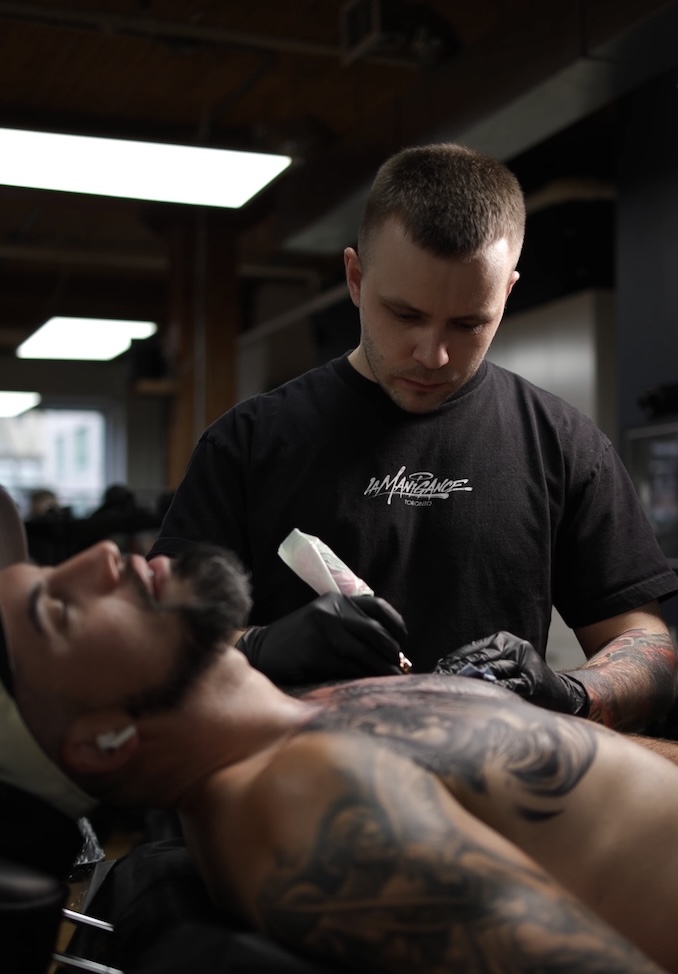
A fresh tattoo proves almost nothing. The real test begins after healing, when pigment loss, tissue recovery, and the skin’s own biology determine whether the work still holds saturation, depth, and clarity. A 2025 review in the Journal of the American Academy of Dermatology notes that tattoo wound healing includes immediate pigment shedding through the epidermis and long-term ink retention in the dermis, which is precisely why lasting quality remains one of the field’s hardest technical problems.
To address that challenge, Roman Sirko, talented tattoo artist and third-place winner of the Quebec Tattoo Show, suggests a distinctive approach to tattooing based on anatomically adapted designs. Working in one of the world’s best-known studios, La Manigance, he specializes in black-and-white and color realism. Before moving to Toronto, Roman was a sought-after artist in Odesa, working within a major Ukrainian tattoo studio network, where he grew into one of its top artists.
Roman came into tattooing through drawing rather than through trend or subculture:
“Art has been part of my life for as long as I can remember. From an early age, I was deeply involved in drawing, took part in visual arts competitions, and often succeeded. And over time, I realized that tattooing was the profession that allowed me to turn that foundation into real work,” he says
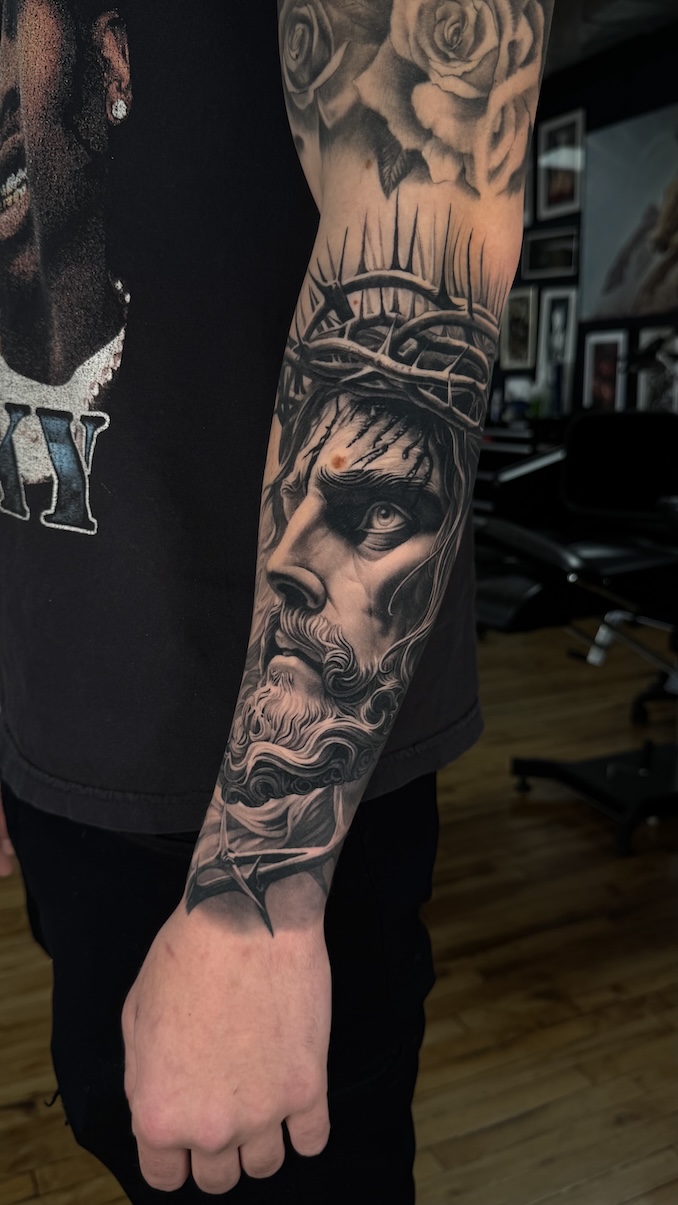
He began tattooing in Odesa, Ukraine, then spent four years developing his craft inside a major Ukrainian studio network, where he conducted seminars and reviewed other artists’ work. Roman was invited to the official openings and asked for recommendations on developing new branches as a leading tattooist for the brand.
With experience, Roman focused on one of tattooing’s most persistent technical problems: a tattoo can look dramatic on day one, then lose density, tonal separation, and structural clarity once healing begins. The field has long placed outsized value on the fresh result, not least because most tattoos are shown immediately after application, when the surface effect can appear especially striking. Yet the real measure of quality emerges later, when pigment retention, skin recovery, and anatomical placement determine what endures. Roman developed his approach to close that gap:
“Tattooing is rarely just about drawing well. It is about placing pigment into living skin in a way that continues to work after the body begins to heal,” the expert explains.
Roman has built his method on that principle. Rather than treating the body as a passive surface and the tattoo as an image simply laid over it, he treats the body as part of the composition itself. He develops each design around the client’s anatomy, taking into account how the image will sit on curves, transitions, and movement so the composition holds together across different angles and body positions, preserving its visual coherence in real life.
The technical side of the method is just as important. Roman centers it on a controlled interaction between needle, skin, and pigment. He carefully manages speed, amplitude, the nature of contact with the skin, the moment of extraction, as well as depth and density, because each factor affects how pigment enters the skin and how evenly it settles there. Compared with tattooing, which prioritizes immediate visual impact, his approach is built around what remains once the skin has healed.
As Roman puts it, “A fresh tattoo can be misleading. It may appear bold in the first photograph simply because the skin is irritated, the tones are compressed, and the surface still carries the immediate visual effect of the procedure.”
That degree of technical control led to an invitation to judge at the Calgary Tattoo & Arts Festival in 2025, a major Canadian event featuring more than 650 local and international artists. There, Sirko served on the judging panel that evaluated contest entries and selected winners across categories.
His method helps him achieve several results that are especially important in tattooing after healing. The most important thing is even, dense saturation without weak spots, because inconsistent pigment placement can leave a tattoo looking patchy once the skin recovers. Roman’s approach also allows him to reduce skin trauma, which matters because excessive irritation can affect both healing and the final clarity of the work. It also supports more predictable healing, making the result less dependent on chance and more consistent from session to session. Unlike tattoos that lose tonal structure after recovery, his method aims to preserve visual depth and detail, keeping the design legible and visually coherent across movement, shifting posture, and real-world viewing. Taken together, these outcomes support the long-term stability of the finished work, helping the tattoo remain clear, balanced, and visually strong well beyond the first days after the session.
The emphasis on long-term quality has also shaped the response to his work beyond the procedure itself. Clients travel to Toronto from different countries, with many coming from the United States specifically for Roman’s custom pieces and difficult cover-ups, including from distant states such as Florida and Texas. The same approach has helped build a six-month waitlist in a competitive market, while his Instagram account gained roughly 15,000 followers in a year without paid promotion. His individually developed designs have also attracted repeated interest from other tattooists within the professional community, and artists in different countries have copied them.
Roman also applies the approach to fully individualized pieces. In such projects, the challenge is to solve several problems at once: how to work with the body rather than against it, how to preserve legibility under difficult conditions, and how to produce a healed result that remains convincing instead of collapsing after recovery. The method has also received formal recognition in competition. At Quebec Tattoo Show 2024, which brought together more than 300 tattoo artists from around the world, he received third place in the Best of Show category from the event’s judging panel.
Roman Sirko’s work reflects a shift in the meaning of quality in tattooing. A strong tattoo does not look impressive on day one, but one that holds clarity, balance, and depth after healing does. That is the standard his approach is built around.
